 A partner you can trust
Stay informed with expert insights, industry trends, and the latest updates to help you make informed decisions.

Most commercial buildings carry electrical infrastructure that was designed for a different era.
The power demands of a modern workplace - high-density IT, multiple screens per desk, server rooms, electric vehicle charging, and round-the-clock security systems - are significantly higher than what older distribution systems were built to handle.
Facilities managers and commercial property owners often defer electrical upgrades until something forces the issue. This approach is understandable but carries a cost that rarely appears on any budget until then.
This article looks at two areas of power infrastructure where the business case for upgrading is clear: electrical distribution systems and backup power. Both sit within Queensbury Construction Group's electrical services and are among the most impactful changes you can make to how your building performs.
Power infrastructure is the network of systems that receives electricity from the grid and delivers it to every part of your building. At its core, this includes your switchgear, distribution boards, main panels and subpanels, and any backup systems such as uninterruptible power supplies (UPS) and generators.
These are not glamorous parts of a building. They sit in plant rooms and risers, largely out of sight. But they govern the reliability of everything else, from the lights and computers to the fire alarm and access control systems.
When they are correctly specified and maintained, they work in the background without issue. When they are not, the consequences become visible quickly.
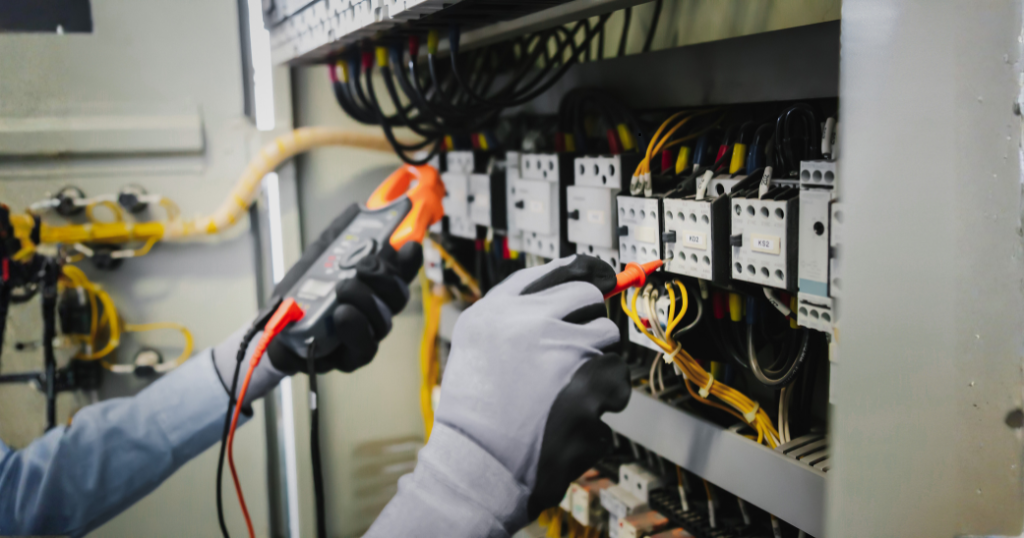
Ageing distribution boards and switchgear cause problems that are easy to dismiss individually but costly in aggregate.
Uneven load distribution stresses equipment and raises energy consumption. Voltage fluctuations damage sensitive electronics over time, shortening the lifespan of servers, screens, and other kit. Systems running at or near capacity leave no room for the incremental additions every occupied building accumulates.
There is also a compliance dimension. Electrical installations in commercial buildings must meet BS 7671, the UK wiring regulations. Older systems may have been compliant when installed but fall short of current standards, particularly where the building use has changed, or the electrical load has grown significantly since the original installation.
A properly upgraded distribution system, with load balancing built in, addresses all of this. It spreads power demand across circuits correctly, reduces the risk of overload, and brings the installation up to current regulatory requirements.
Upgrading electrical distribution does not always mean starting over. In many commercial buildings, the main panel and subpanels can be replaced or updated while the wider infrastructure remains largely in place.
Queensbury's approach starts with understanding how your building uses power. We examine where loads sit, where capacity is stretched, and where new demand may come from, whether a planned fit-out, additional tenants, or EV charging infrastructure.
From there, switchgear and distribution boards are specified to match current and anticipated demand, with load balancing built in. The result is a system that supports your building's operational needs today and has room to grow.
Power outages are common. Research widely cited in the UK facilities sector shows power issues cause over 50 per cent of major outages affecting UK businesses. Even short interruptions lasting seconds can trigger automated shutdowns, corrupt data, and halt operations that take time to restart safely.
For commercial property owners and facilities managers, the financial case for backup power comes down to a simple calculation: how much does an hour of downtime cost your building's occupiers, and how does that compare to the cost of proper protection?
The answer varies by sector, but research consistently shows unplanned downtime costs UK businesses hundreds to thousands of pounds per hour, with larger organisations facing higher figures. Prevention is almost always more cost-effective.
A UPS provides an immediate bridge between mains failure and either supply restoration or generator cut-in. It responds in milliseconds, giving building systems and occupiers time to react without data loss, equipment damage, or sudden shutdowns.
In practice, this protects servers and IT infrastructure from corruption, keeps access control and security systems online, maintains lighting and life safety systems during transition, and gives tenants and staff time to save work and shut down safely if needed.
UPS systems also regulate power quality during normal operation. They filter voltage fluctuations and spikes that degrade sensitive equipment over time. This extends the lifespan of the building's electrical kit and reduces faults requiring reactive maintenance.
Where a UPS buys you minutes, a generator buys you hours. For commercial buildings where continuity is non-negotiable, a generator working with a UPS and an automatic transfer switch (ATS) creates a complete backup power chain.
The ATS makes the transition work. It detects mains failure and automatically switches the building to backup power without manual intervention. The switch happens before most occupants notice an interruption.
Queensbury installs high-capacity generators for commercial applications, sized to the building's load requirements and tested to confirm they will perform when called upon. A backup system that has never been load-tested is not a reliable safety net.
There are several points in a building's life when upgrading power infrastructure is a natural fit.
A planned refurbishment or fit-out is the most obvious time. When tenants move out, and the building is reconfigured, electrical works can be done with minimal disruption. Doing it then is significantly less costly than retrofitting an occupied floor.
A change in use or tenant mix is another trigger. A building that once housed a single occupier on light office use may now need to serve multiple tenants with much higher power demands. The original distribution may not have the capacity or the circuit structure to support that.
Sometimes, the trigger is simply age. Distribution boards and switchgear have a finite lifespan. If your installation is over 25 years old and has not been reviewed, a condition survey is a sensible starting point before a fault forces the decision.
Common signs include tripping circuit breakers, visible signs of overheating on distribution boards, frequent power fluctuations, or an installation that has not been formally inspected in the past five years. If your building use has changed significantly since the original installation, or if new electrical loads have been added without a capacity review, a condition survey by a qualified electrical engineer should be your first step.
A UPS provides instant backup power the moment mains supply fails, typically for minutes rather than hours. Its role is to protect equipment from abrupt shutdowns and buy time for a safe transition. A generator provides sustained power over hours but takes time to start and stabilise. In most commercial settings, the two systems work together: the UPS covers the gap while the generator starts, and an automatic transfer switch manages the handover between sources.
It depends on the scope and how the works are planned. Distribution board replacements and panel upgrades can often be phased across circuits, with individual sections isolated in turn while the rest of the building remains live. Electrical works in occupied buildings are common and manageable with the right pre-construction planning. The most disruptive scenario is carrying out unplanned works reactively after a fault, which is precisely what a proactive upgrade is designed to prevent.
All fixed electrical installations in commercial buildings in England and Wales must comply with BS 7671, the IET Wiring Regulations. Installations are also subject to the Electricity at Work Regulations 1989, which require duty holders to maintain electrical systems in a safe condition. For commercial properties, a periodic inspection and testing report (EICR) is the standard way to demonstrate compliance and identify where remedial works are required. The recommended frequency for offices and commercial premises is every five years.

tackling everything from changes in planning policy to home renovation advice
Contact Us



Leave A Comments
Your comment will be reviewed before it appears. Spam protection is active.